


Basilica Cistern
History
-
330
Roman Emperor Constantine I, who began refounding the city in 324, inaugurated it as the new capital of the empire on 11 May 330. As there was no large river on the Historic Peninsula, the city’s water was brought from afar through aqueducts from the reign of Hadrian onwards, and stored in wells and cisterns.
-
527–565
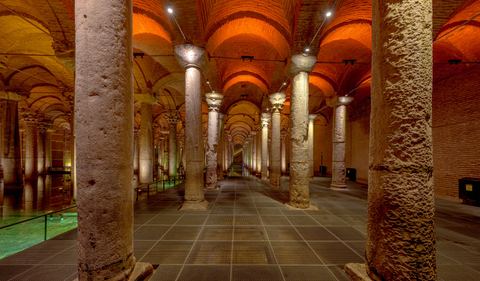
The Basilica Cistern was built under Justinian I by digging deep beneath the great courtyard of the Stoa Basilica, a public building with colonnades on all four sides. The Byzantine historian Procopius records that the cistern was made to store the abundant winter water for the summer months. Most of the 336 columns that carry its vaults are pieces brought from older buildings. Its water came from springs in today’s Belgrad Forest area north of the city, most likely through the Hadrian Aqueduct.
-
6th–15th century
After the cistern was built, the city remained the capital of the Byzantine Empire until 1453, apart from the Latin period between 1204 and 1261. Over these centuries the city was shaken by major earthquakes in 557, 740, 869 and 989; the cistern was damaged at times but remained standing.
-
1453
After the Ottoman conquest of the city in 1453, the cistern went on supplying water to Topkapı Palace for a time. As the area filled with houses, it became a water source for the neighborhood as well.
-
1544–1547
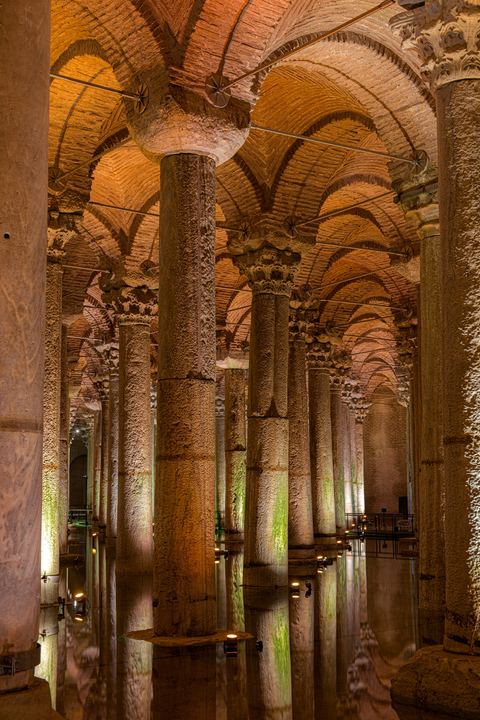
Unknown to the Western world until the mid-16th century, the cistern was rediscovered by Petrus Gyllius, who studied it while in Istanbul between 1544 and 1547 and made it known to scholars. According to Gyllius it was the largest water reservoir in Constantinople and, by his measure, about 336 feet long and 182 feet wide; its circumference is recorded as 224 Roman paces.
-
1955–1960
Repaired in the Ottoman period under Ahmed III and Abdülhamid II, the cistern was restored again in the Republican era. Between 1955 and 1960 there was construction work near the cistern; some of the columns were in danger of breaking, and their shafts were wrapped in a thick concrete casing.
-
1985–1987
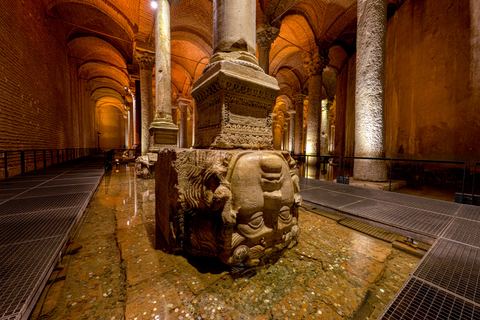
During the extensive restoration and cleaning of these years, the Medusa-head column bases, among the cistern’s most striking features, were uncovered. One lies upside down, the other on its side; they are regarded as original works of Roman sculpture.
-
Today
After its restorations, the cistern has become one of Istanbul’s most visited monuments and has received many heads of state and official guests. It still holds an important place in the city’s cultural and tourism life.
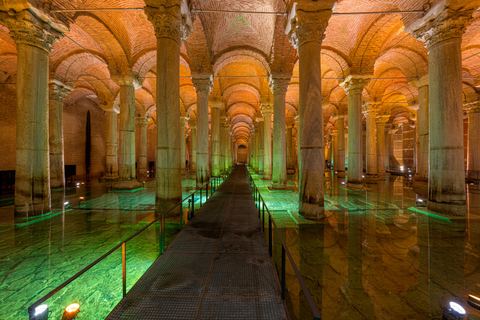


Fifteen centuries on, the cistern still welcomes visitors, who now walk above the water.
Next
See the cistern for yourself